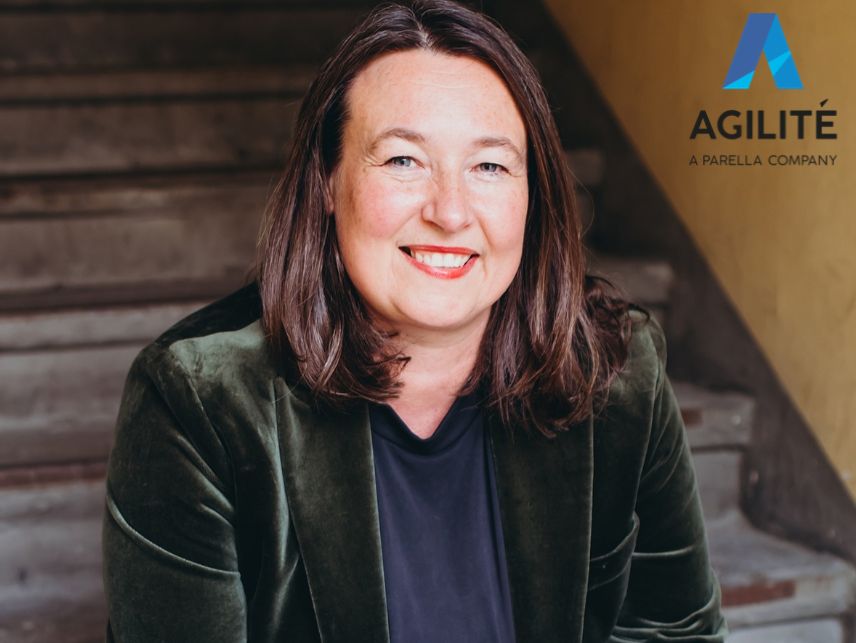
In this month’s spotlight, we’re pleased to feature Agilité, an international commercial interiors specialist delivering office, retail and hospitality fit-outs across Europe. Alongside its project work, Agilité supports initiatives that are helping move the built environment towards more responsible and circular ways of working. Its support for Circular Berlin reflects a shared belief that meaningful change depends on collaboration across sectors, from businesses and supply chains to researchers, communities and grassroots organisations. For smaller non-profits, unrestricted support can make a real difference by helping them remain independent, responsive and focused on the work that matters most. We spoke to the Agilité team about why they chose to support Circular Berlin, how they approach sustainability within their own business, and the role organisations like ours can play in accelerating the transition to a more circular economy. We talked to Sara Purvis, country head (Germany) at Agilité.
What drives an organisation like Agilité to support grassroots NGOs like Circular Berlin, and what stood out about our mission when deciding to contribute?
It’s safe to say that the transition to a more circular built environment won’t happen through one organisation, project or part of the industry acting alone. Circular Berlin stood out to us because of the
practical way you bring different people together around circularity – from policy and research to business, design and community action. That kind of cross-sector conversation is important because
it helps turn big ambitions into something more tangible and locally relevant. As a general contractor, we see first-hand how much impact sits within decisions around materials, procurement, reuse, waste and supply chains, so supporting organisations that are creating space for
better collaboration and more experimentation feels like a useful way for us to contribute beyond our mown projects. And, importantly, we don’t think every partnership has to come with a commercial return attached. mSometimes supporting good work because it aligns with your brand values is reason enough.
Defining and measuring sustainability impact is notoriously complex. Having earned the mEcoVadis Silver award in 2026 with a high-performing score across environmental, social and methical criteria, how does Agilité strategically turn sustainability commitments into measurable reality?
We try to avoid treating sustainability as a separate workstream – instead looking at how our commitment to being a responsible business influences the way we plan, procure, deliver and improve projects day-to-day. In practice, it means putting systems around the areas we can measure and being equally open about the areas where our data still needs to improve, using frameworks and external assessments such as EcoVadis, B Corp and our ISO-certified management systems. nInternally, we’re looking at carbon measurement, project life cycle assessments, supplier engagement, responsible procurement, waste data and client feedback. We’re also working to improve the quality and consistency of environmental data across projects, in order to give our teams a stronger basis for decision-making. Our B Corp, Ecovadis and ISO certifications give us a positive external benchmark of course, but the real value sits in using that feedback to keep improving rather than treating the score itself as the end point.
From your perspective in the private sector, what unique role do non-profit organisations mplay in accelerating the shift toward a truly circular economy?
Non-profits can often do something businesses find harder to do: create neutral spaces where people mcan share ideas, challenge assumptions and test approaches without everything being filtered
through a commercial objective. That matters in circularity, because the barriers are rarely technical alone and take into consideration
behaviour, incentives, regulation, procurement, knowledge and trust between different parts of the value chain. Organisations like Circular Berlin can connect those pieces and bring together voices
that might not otherwise sit at the same table – helping to make circular thinking more accessible and practical. From a private-sector perspective, that’s incredibly valuable, because while businesses may have the mscale, resources or project opportunities to implement change, non-profits can help create the mnetworks, knowledge and momentum that make that change easier to achieve. The relationship works best when it’s genuinely two-way: businesses can provide funding, practical minsight and routes to implementation, while non-profits bring independence, convening power and fresh thinking.